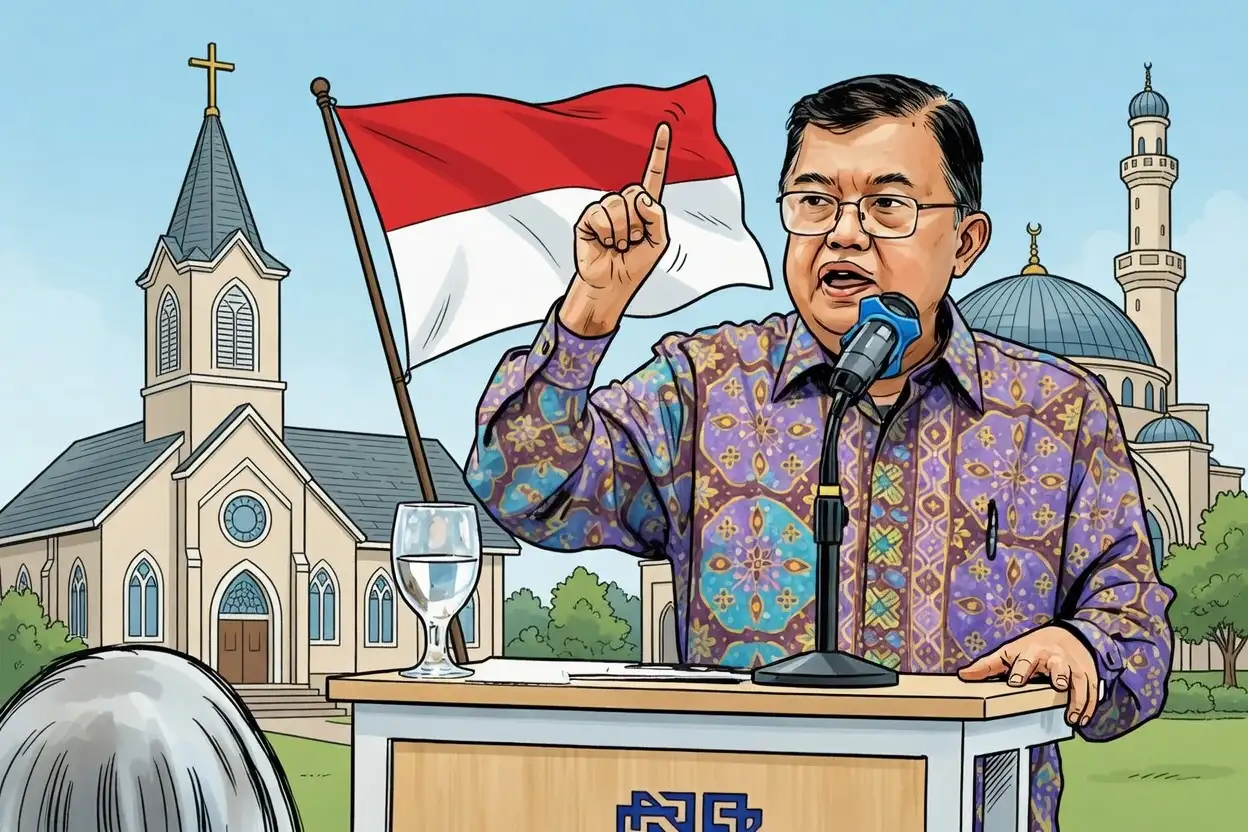
Jusuf Kalla’s remarks on “syahid” sparked public backlash. Yet beyond the controversy lies a deeper issue: how religious language operates—and often misfires—in a plural society like Indonesia.
In recent weeks, public discourse in Indonesia has been stirred by controversy surrounding a sermon delivered by former Vice President Jusuf Kalla (JK). Speaking at the UGM Campus Mosque, JK suggested that in certain conflicts, both Muslim and Christian groups have, at times, embraced narratives in which killing an “enemy” could be framed as a path to heaven (Sari 2026). His remarks quickly drew criticism, particularly from Christian communities who found the use of the term syahid in a Christian context inappropriate (Tempo.co 2026; RMOLSumut.id 2026; CNN Indonesia 2026).
At its core, this controversy is not merely about word choice. It reflects a deeper failure to understand how religious terms function across traditions in a plural society.
What we are witnessing is a recurring problem: how religious language shifts meaning as it crosses theological and cultural boundaries—especially in public spaces like Indonesia, where diversity is accompanied by heightened sensitivity to identity.
In Islamic tradition, the term syahid is commonly understood as referring to someone who dies in the path of God, although classical literature shows that its meaning is far broader and more complex. Etymologically, syahid simply means “witness.” Interestingly, a parallel concept exists in Christianity through the Greek word martus, from which the term “martyr” is derived. Both terms share the same basic meaning: “witness.”
Yet history has led them down different paths.
In early Christianity, martus evolved beyond its general meaning into a powerful symbol of ultimate faithfulness, even unto death. The story of Polycarp—a bishop who remained steadfast in his faith despite being burned alive—illustrates how the notion of “witness” came to signify radical testimony (Holmes 2007; Moss 2013).
In Islam, the term syahid underwent a similar process of theological development. It became not only a spiritual concept but also one tied to historical struggles and conflict (Homerin 1999; Cook 2007). Thus, while both traditions share a common linguistic root, they developed within distinct theological and historical frameworks.
This is where the problem arises: religious terms are never truly neutral.
Interestingly, in some Arab Christian communities, the term syahid is indeed used. The Coptic Church in Egypt, for instance, refers to its martyrs as al-Syahīd (Griffith 2008). This suggests that religious language can be flexible and adaptive, depending on cultural context.
Indonesia, however, is not the Middle East.
In Indonesia, Arabic has long been associated with Islamic identity. As a result, when Arabic terms are used outside that context, they are rarely perceived as neutral. Instead, they carry strong identity markers. This is evident, for example, in the debate over changing the term “Isa Almasih” to “Yesus Kristus” in the national holiday calendar (Rizqo 2024). What was contested was not merely a label, but the authority to define religious identity.
Within this context, JK’s use of syahid to describe Christians becomes both understandable and problematic. On one hand, it may have been intended as a familiar term for a predominantly Muslim audience. On the other, for many Christians, the term feels alien—or even inappropriate.
The issue becomes even more complex when we consider the context JK was referring to, namely communal conflicts such as those in Poso, where, in certain cases, religious narratives were used to frame and justify acts of violence. In such settings, syahid is not just a theological concept, but part of a broader narrative of conflict (Khadduri 2006; al-Zuhayli 2011; Hasyim 2015).
The challenge is clear: language that resonates with one community may alienate another.
So how should such controversies be addressed?
Pursuing legal action may appear decisive, but it does little to address the underlying issue. What is at stake here is not simply a matter of legal violation, but a clash of interpretations. Without efforts to bridge these differences, conflict is unlikely to disappear—it will merely take new forms.
In this regard, dialogue offers a more meaningful path forward. The perspective of Mahatma Gandhi provides a useful lens: responses to injustice need not always take the form of confrontation, but can instead be grounded in reflective nonviolence (Gandhi 1963). Such an approach may seem counterintuitive, yet it resists the logic of retaliation.
A similar principle can be found in Christian teachings. Jesus’ words on the cross—“Father, forgive them, for they do not know what they are doing”—are often misunderstood as weakness. Yet they represent a profound refusal to respond to hatred with hatred.
In moments like this, the more urgent task is not to prove who is right, but to ensure that we do not deepen our mutual misunderstandings.
Ultimately, the debate over syahid reminds us that religious language is not merely a tool of communication, but a site where meaning and identity are contested. When the same term is used without awareness of its differing meanings, what emerges is not understanding, but suspicion.
If religious terms continue to be guarded as exclusive identity markers, what we preserve is not faith—but distance.
Referenses
- Cook, David. 2007. Martyrdom in Islam. Cambridge: Cambridge University Press.
- Gandhi, Mahatma. 1963. The Message of Jesus Christ. Edited by Anand T. Hingorani. Mumbai: Bharatiya Vidya Bhavan.
- Griffith, Sidney H. 2008. The Church in the Shadow of the Mosque: Christians and Muslims in the World of Islam. Princeton: Princeton University Press.
- Hasyim, Syafiq. 2015. “The Concept of Jihad and the Contemporary Challenges.” Journal of Islamic Studies 22 (2): 110–135.
- Holmes, Michael W., ed. 2007. The Apostolic Fathers. 3rd ed. Grand Rapids: Baker Academic.
- Homerin, Th. Emil. 1999. “Shahīd.” In Encyclopaedia of Islam, 2nd ed., edited by P. Bearman et al. Leiden: Brill.
- Khadduri, Majid. 2006. War and Peace in the Law of Islam. Clark, NJ: Lawbook Exchange.
- Moss, Candida R. 2013. The Myth of Persecution: How Early Christians Invented a Story of Martyrdom. New York: HarperOne.
- Pujiati, Pujiati, Adri Lundeto, and Ikmal Trianto. 2025. “Representing Arab-Indonesian Identity: Language and Cultural Narratives on Social Media.” International Journal of Applied Linguistics 14 (3). https://doi.org/10.17509/ijal.v14i3.78286.
- Rao, K. L. Seshagiri. 1969. Mahatma Gandhi and C. F. Andrews: A Study in Hindu-Christian Dialogue. New Delhi: Deep & Deep Publications.
- Rizqo, Kanavino Ahmad. 2024. “Jokowi Resmi Ubah Nomenklatur Libur ‘Isa Almasih’ Jadi ‘Yesus Kristus’.” detikNews, January 30, 2024. https://news.detik.com/berita/d-7167495/jokowi-resmi-ubah-nomenklatur-libur-isa-almasih-jadi-yesus-kristus.
- RMOLSumut.id. 2026. “GAMKI: Ceramah Jusuf Kalla Menyakiti Umat Kristen.” April 14. https://www.rmolsumut.id/gamki-ceramah-jusuf-kalla-menyakiti-umat-kristen.
- Sari, Haryanti Puspa. 2026. “Menjelaskan Pernyataan Jusuf Kalla, Meluruskan Peristiwa.” Kompas.com, April 14.
- Tempo.co. 2026. “Jusuf Kalla Dilaporkan ke Polda Metro Soal Ceramah di UGM.” April 14. https://www.tempo.co/hukum/jusuf-kalla-dilaporkan-ke-polda-metro-soal-ceramah-di-ugm-2128554.
- Wahid, Abdurrahman. 2006. Islamku, Islam Anda, Islam Kita. Jakarta: Wahid Institute.
- Yul, Widiya, and Riko Andrian. 2024. “Indonesian Muslims and Arabic Language: Leaves and Light in the Realm of Religi-Linguistics.” Alsinatuna 10 (1). https://doi.org/10.28918/alsinatuna.v10i1.8499.