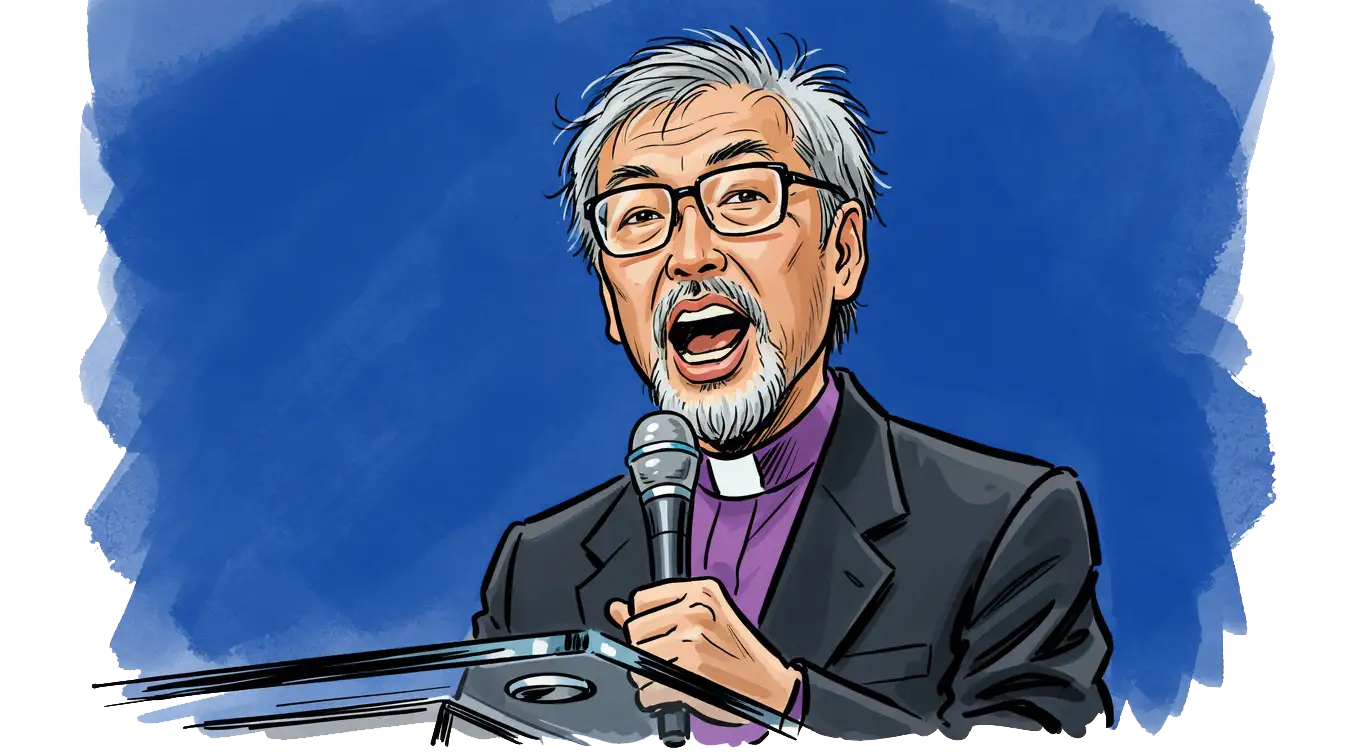
Every April 4th is often remembered as the “Celebration of Freedom” (COF), marking the moment when Abuna K.A.M. Jusuf Roni was released from prison. Yet now, that meaning feels different. Nearly a year has passed since he returned to the Father’s house in Heaven, closing a life journey marked by meaning, courage, and a powerful testimony of faith.
Abuna was not someone who enjoyed being remembered through praise or heroic narratives about himself. He could speak enthusiastically about his experiences, yet he would visibly grow uncomfortable when those stories were met with admiration for his strength or success. In contrast, when the conversation turned to teaching and ideas, his face would radiate an unmistakable passion. Time seemed to move swiftly as he unfolded his thoughts, even the most complex ones.
In his final days, before illness struck, I encountered him several times unexpectedly—in the parking lot of his office, without any prior arrangement. Yet it was there that long and meaningful conversations would unfold. Whenever a new idea stirred his mind, he would invite discussion, regardless of place or circumstance. For him, truth and understanding were not confined to formal settings.
Once, I asked him, “Why is it called Celebration of Freedom?” His answer was simple yet profound: “This is not my freedom, but the freedom to express faith.” That response reflected his entire life. Freedom, for him, was never about himself, but about the space to bear witness.
Having endured years of imprisonment because of his faith, Abuna did not emerge as a harsh or aggressive figure. Pain did not shape him into someone defensive or combative. Instead, it formed him into a bridge-builder, seeking kalimatun sawa’—common ground—with Islam. He believed that mission was not about winning arguments, but about sharing the Good News through sincere and peaceful dialogue.
He often emphasized that the Gospel is “Good News.” Therefore, it must be conveyed in a good way—not by belittling others or judging them, but by inviting them to walk together in respectful conversation. He called this approach “parallel dialogue.”
After his passing, I met a missionary from South Korea who had come with one purpose: to learn about Abuna’s thoughts and approach. He had traveled to many places in search of answers but had yet to find a complete understanding of Abuna’s ideas. To him, Abuna’s thinking was extraordinary—something he had never encountered before in his study of mission and evangelism. Even his mentor in Korea admired it. Yet he wondered why such a remarkable perspective seemed almost forgotten in the very place where it was born.
That encounter became a mirror of reflection. Those of us who had learned directly from Abuna were confronted with an uncomfortable truth: we had often failed to fully appreciate the legacy of his thought. It was a humbling realization—that what is closest to us is often what we overlook the most.
I recall a conversation in his office at Alfa Indah. He asked me, “Yos, do you still remember why I chose the name Kemah Abraham for our church?” I simply smiled, and from his returning smile, I knew he trusted that I remembered.
Abraham is a figure through whom two great lineages—Isaac and Ishmael—emerged, shaping the religious landscape of the world. Yet before those differences became divisions, they once lived, grew, and learned together under one tent. It was there that faith was passed down—not in separation, but in togetherness.
That was the heart of Abuna’s vision. He longed for religions rooted in Abraham to rediscover a shared space—where mutual respect, understanding, and peaceful dialogue could flourish.
Now, Abuna is gone. But his question remains: will we allow his thoughts to fade, or will we dare to carry forward his legacy—building a “tent” that creates space for encounter, rather than division? []